
Peyote stitch for beginners
Updated November 18, 2026
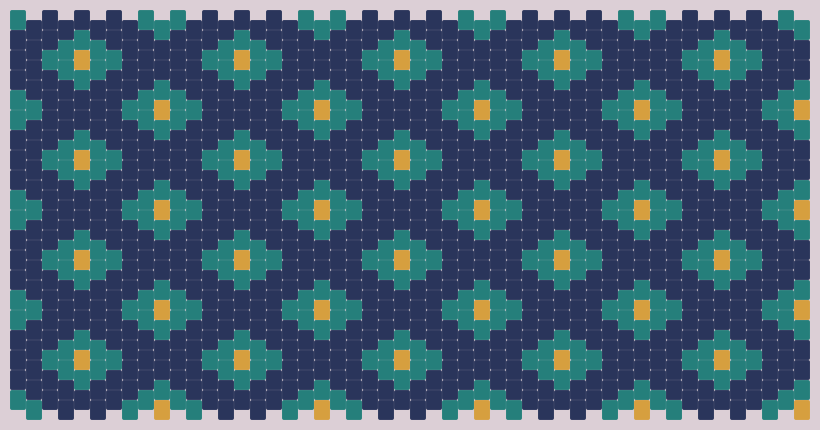
Peyote stitch is one of the most useful stitches in beadweaving. Beads lock together in a staggered, brick-like fabric that lies flat, drapes well and shows a pattern crisply, which is why it is so popular for cuffs, bookmarks and earrings. This guide covers flat even-count peyote, the easiest version to learn.
What you need
- Cylinder beads, such as Miyuki Delica 11/0. Their even size and straight sides make the rows line up neatly. Our Delica color chart lists every color by code, and Delica vs seed beads explains why cylinders suit peyote. Start with two colors that contrast, so you can see each row.
- Beading thread, such as a braided thread or a nylon beading thread, in a color close to your beads. Our thread and needles guide explains the difference.
- A beading needle, size 10 to 12. It has to pass through each bead more than once.
- Small scissors, and a mat that stops beads from rolling away.
How the stitch works
The first thing you string is really two rows at once. As you work the next row, every other bead rises and the others drop, leaving gaps. Each new bead sits in one of those gaps. The beads that stand tallest are called up beads, and they are always the ones you stitch through next.
Step by step
- Add a stop bead. Cut about 1.5 m (5 ft) of thread and pass through one spare bead twice, leaving a 20 cm (8 in) tail. It keeps your work from sliding off, and you will remove it later.
- String an even number of beads. Six is a good first swatch. These are rows one and two.
- Add the first bead of row three. Pick up bead 7, skip bead 6, and pass through bead 5. Bead 7 now sits on top of bead 6.
- Keep going to the end. Pick up bead 8, skip bead 4, and pass through bead 3. Pick up bead 9, skip bead 2, and pass through bead 1.
- Turn and start row four. Pick up bead 10 and pass back through bead 9, the last bead you added. Each new row now fills the gaps between the up beads.
- Repeat. Pick up a bead, skip the next low bead, and pass through the next up bead. Gently pull the thread snug after every few beads.
To finish, weave the thread back through the beadwork along a zigzag path, changing direction a few times, then trim it close. Remove the stop bead and weave in the tail the same way. To add new thread, weave it in from a few rows back so that it comes out of the last bead you worked. Each step is shown in how to add and end thread.
How to read a peyote chart
On a peyote chart the columns are offset by half a bead, exactly like the finished piece. Work from one end, a single row at a time. A row runs diagonally back and forth across the columns, so it only includes every other bead you can see. The first two rows on a chart are the beads you string at the start.
Many patterns also come with a word chart, which lists each row as a color and count, such as “2 pink, 1 gold”. Mark your place as you go, because losing your row is the most common mistake in a long pattern. For more on keys, lettered charts and word charts, see how to read a bead pattern.
How to size a bracelet
Delica 11/0 beads are about 1.3 mm long and 1.6 mm wide. With the thread running across the width of a bracelet, that gives you roughly:
- Width: 7 to 8 beads per centimeter.
- Length: about 6 beads per centimeter along each column, which is 12 rows.
These numbers shift with your tension, so stitch a small swatch and measure it before you commit to a long piece. Remember to allow for the clasp. The bead calculator does the sums for you: enter your wrist size and band width, and it tells you how many beads to string and buy.
Common beginner problems
- The edges look uneven. Check the tension at each turn, and make sure you passed through the last bead you added.
- A bead does not sit in its gap. You probably skipped an up bead instead of a low one. Unpick back to that bead by pulling the needle off and easing the thread out.
- The piece curls. Tension that is too tight usually causes this. Relax your pull a little, and let the thread settle.
- The rows look crooked. Beads of uneven size can do this, especially if they are not cylinder beads.
Where to go next
Once even-count feels natural, try a simple two-color motif. After that you can explore odd-count peyote, which needs a slightly different turn on one edge, and two-drop peyote, which works up faster by treating two beads as one.
Ready for a full pattern? Our free geometric diamond peyote bracelet is 12 beads wide with a word chart for every row, and there are more in our free patterns.