
How to read a bead pattern
Updated November 16, 2026
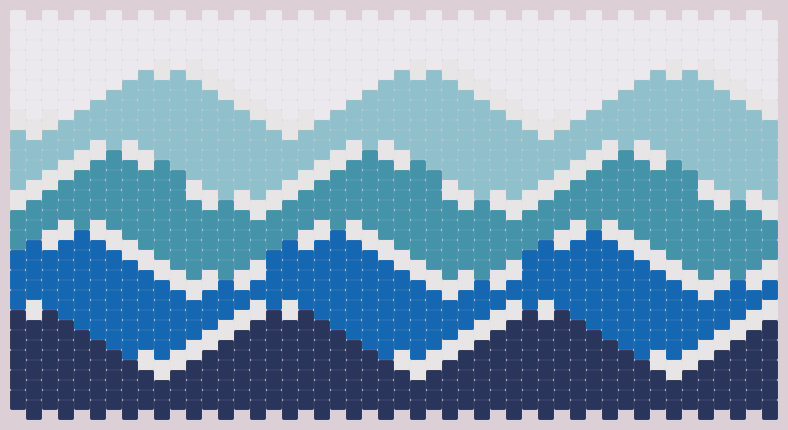
A bead pattern looks like a picture made of tiny squares, and that is almost exactly what it is: each square is one bead. Once you know how the parts of a pattern fit together, you can follow a chart for any stitch. This guide walks through what you will usually find in a pattern, and what changes between loom, peyote, brick stitch and rope charts.
What is in a pattern
Most bead patterns, including the PDFs from the ShineBead app, include some or all of these parts:
- A color chart: the design drawn as a grid of beads, in color.
- A lettered chart: the same grid with a letter in every bead, so that you can follow it in black and white, or tell similar colors apart.
- A word chart: the design written out as text, row by row, such as “3 A, 2 B, 5 A”.
- A color key: the list of beads used, with a letter for each, the bead’s code and how many you need.
- The finished size, the number of beads in each row and the number of rows.
Start with the color key
The key tells you which bead goes where. Each color has a letter or symbol, the bead’s name, and usually a code such as DB0010. For Miyuki Delica beads, the code is what matters: names are not always the same from shop to shop, but the code is. Our Delica color chart shows every code with its color.
Check the quantity column before you buy. Patterns usually give a count or a weight for each color. If they only give a count, Delica 11/0 beads come to about 195 per gram, so you can work out the grams yourself, and add a little extra for beads that are misshapen or lost.
Grid charts and lettered charts
The grid chart is your map. Find the starting point first: it is usually marked, or explained in the pattern’s notes. Then check the orientation. Bracelet patterns are often drawn sideways to fit on the page, so the first row may run down the side of the chart rather than across the top.
If two colors look alike on screen or on paper, switch to the lettered chart. It shows the same design with a letter in every bead, matching the key.
Word charts
A word chart turns the picture into a list you can read aloud: row 1, then row 2, each with the beads in order. It is the easiest way to follow a long pattern, because you never have to count squares. Tick off each row as you finish it.
Read the direction note. Some word charts read every row from left to right, and some change direction on every row, the way you work back and forth.
What changes from stitch to stitch
- Loom and square stitch: the simplest charts. The grid on the page is the grid on your piece, with no offset. Each row of the chart is one row of beads. See our loom and square stitch guides.
- Peyote: every other column sits half a bead lower, like a zigzag. The first two rows are strung together at the start, so peyote word charts often list “rows 1 and 2” as one line. See the peyote guide.
- Brick stitch: every other row sits half a bead to the side. You usually start from the widest row, which becomes your ladder, and work toward each end. See the brick stitch guide.
- Bead crochet rope: the chart shows the pattern unrolled flat, but you follow the stringing order, the long list of beads to thread before you start crocheting. See the bead crochet rope guide.
Tips for keeping your place
- Print the pattern and mark each row as you finish it, with a pencil or a highlighter.
- Use a ruler or a strip of paper under the row you are working on.
- Count before you move on. One bead too many or too few shifts every row after it.
- Sort your beads into small dishes labeled with their letters from the key.
Make your own
To draw your first one, follow how to design your own bead pattern step by step. Every design you draw in the ShineBead app comes with these same parts: a color chart, a lettered chart, a word chart and a bead list with the count of each color, ready to print or to sell with your pattern. If you need to work out how many beads a bracelet takes, the bead calculator gives you the rows, the beads in each row and the grams to buy. To sketch a chart of your own by hand, print some bead graph paper drawn in Delica proportions.